Name:__Master Correction _ GEO 302c
Lab 1
Climate: Past, Present, and Future
Lab#1: Energy Reflectance and Absorption
Definitions:
Blackbody: A blackbody is a hypothetical body (a coherent mass of any material) comprising a sufficient number of molecules absorbing and emitting electromagnetic radiation in all parts of the electromagnetic spectrum so that
· all incident radiation is completed absorbed (hence the term BLACK), and
· in all wavelength bands and all directions the maximum possible
emission is realized.
Solar radiation: Solar radiation is comprised of electromagnetic waves having magnetic and electrical properties. They do not need molecules to propagate them. In a vacuum, they travel at a constant speed of nearly 300,000 km (186,000 mi) per second -- the speed of light. Solar radiation releases "heat" energy when it is absorbed by an object; this energy released from earth into space is in the form of infrared energy. By the Law of Conservation of Energy, flux in is equal to flux out.
Albedo: The albedo of a planet is defined as the ratio of reflected, or outgoing, solar radiation to incoming solar radiation. Snow has a high albedo, hence, a greater capacity to reflect light than say, a woodland forest, or a rocky desert.
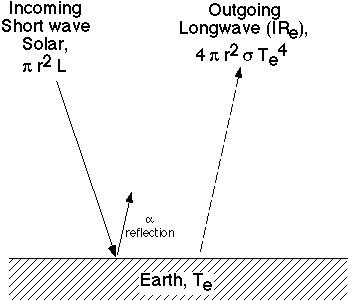
Case 1: Blackbody Earth
Consider a spherical planet “Earth” with no atmosphere. Energy from the sun (solar radiation) pours down onto earth and is reflected back from the surface as infrared light.
The amount of energy coming into the planet is given by
Flux
In = (1-a) pr2S
where:
a=albedo (reflectivity)
S = intensity of sunshine, 1380 W/m2
r = radius of a circle
pr2 = the area of the circle onto which the sun’s radiation falls
Assuming this “Earth” is a blackbody, the Stefan-Boltzmann law describes the rate of energy being lost by outgoing infrared light as a function of surface temperature, by
Flux
Out = 4pr2 sTe4
Where:
s = Stefan-Boltzmann constant, 5.7 x 10⁻⁸ W/m2K4
Te = Temperature of the earth’s surface
4pr2 = the area of a sphere (Earth)
Since the radiation flux in must equal the flux out, we can write
(1-a) pr2S = 4pr2 sTe4
and simplify this to
S(1-a)/4 = sTe4
Problems:
1. Express your answers in degrees Kelvin (K)
a) Calculate Earth’s equilibrium temperature Te for an average albedo of 0.33. Why is the temperature lower/higher than the observed average temperature of about 16°C or 289.15 K ?
b) Calculate the Earth’s equilibrium temperature Te during a glacial period, where albedo = 0.75.
2. On any available computer, go to the website
http://www.worc.ac.uk/Departs/Envman/Staff/Rowland/ums/env/mec/Models/albedo.html
Read the pop up window, “Hints on Using the Model”.
Using the albedo values given for different landscapes, calculate reflected energy out for the following:
a) average earth
b) equatorial marine environment
c) the
d) alpine forest
e)
Bonus:
f)
White Sands,
g) What
would you guess is the typical range of albedo values for
Notes
· “Energy In” should remain a constant, 1370 W/m2
· Please use only albedo values listed on website.
Answers
for Question #2
Environment |
Albedo Value |
Energy In |
Energy Out |
|
a) Average Earth |
|
1370 |
|
|
b) Equatorial Marine |
|
1370 |
|
|
c) The |
|
1370 |
|
|
d) Alpine |
|
1370 |
|
|
e) |
|
1370 |
|
|
f) White Sands, NM |
|
1370 |
|
|
g) |
|
1370 |
|
3. Thought Question:
Knowing what you know now about solar radiation loss to reflection, and it’s dependency on the albedo of the planet…
a) Would you expect the temperature of an ice-covered planet to increase or decrease over time? Why? What would be the result of this trend?
b) Give
some brief reasons other than the albedo as to why the Earth’s mean
temperatures fluctuate through time. How is the Earth able to recover from
extensive periods of glaciation or greenhouse conditions? A full treatise on the dynamics of Earth’s climate is not necessary,
just a few brief observations taken from readings and lectures as to why the
“Blackbody Earth” is not a complete picture.