Research
Much of my research has centered upon the evolution of magmatic systems and
their interaction with continental crust. This has included work in volcanic
fields associated with the southern portion of the late-Tertiary Basin and Range
extensional province in northern and central Mexico; mid-Tertiary subduction-related
magmatism in the Sierra Madre Occidental in northwestern Mexico; and
late-Tertiary intraplate, post-collisional magmatism in western New Guinea.
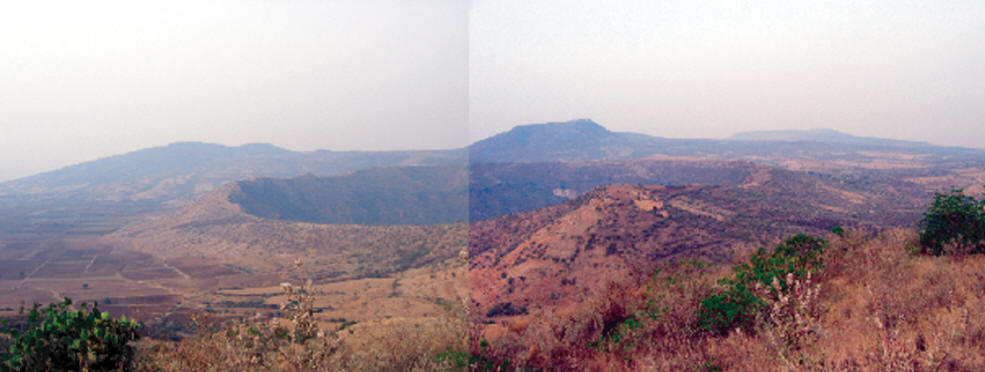
Hoya de Alvarez: a Pleistocene maar in the Valle de Santiago volcanic field,
Guanajuato, where earlier calc-alkaline subduction-related volcanism has changed
over to mafic-alkalic volcanism associated with maar complexes and late lava
flows.
In the Basin and Range province in central and southern Mexico, where Dr. Housh
has been working with J.F. Luhr and J.J. Aranda-Gómez, they have studied several
mafic alkali volcanic fields. Some of the questions they are working to address
include: What were the relative influences of interaction between asthenospheric
and lithospheric mantle and continental crust in the evolution of the magmas
erupted in these fields? Is a progression in time from lithospheric-dominated
magmas to magmas generated seen in the asthenosphere as has been postulated for
the SW United States? Are there differences in the evolution of magmas within
small volcanic fields versus large volcanic fields? What role did extensional
faulting play in the observed distribution of volcanism? Why are there very
similar volcanic fields outside of the area of extension associated with the
southern part of the Basin and Range extensional province?
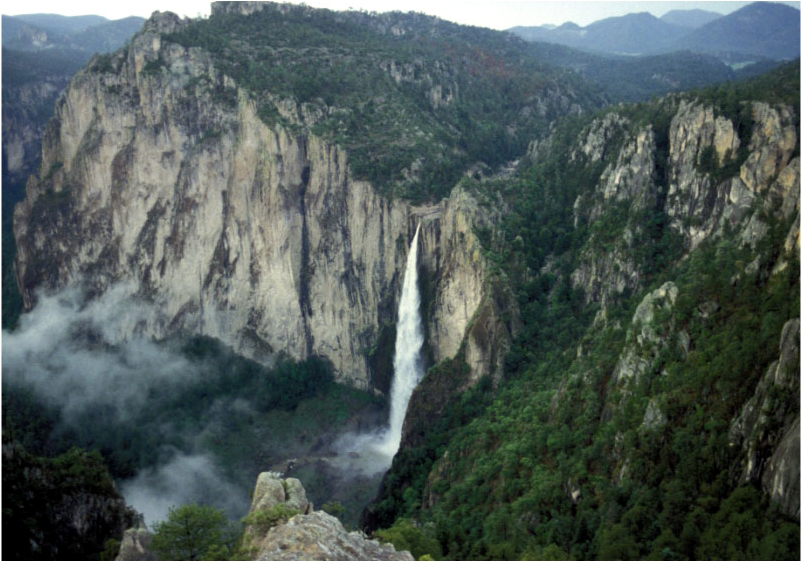
Cascada de Basaseachic; a waterfall with a drop of 312 m in intracaldera facies
tuff of the ca. 30 Ma Ocampo caldera, western Chihuahua.
I am also involved in radiogenic isotope and geochemical
studies of mid-Tertiary subduction-related volcanic rocks in the Sierra Madre
Occidental with Fred McDowell. We have found systematic regional variations in
the radiogenic isotopes of intermediate and silicic magmas in northwestern
Mexico. Two of the questions they have sought to address in this study are: Can
these variations be related to changes in the nature of the subsurface
crystalline basement within the region (e.g. Laurentia and accreted terranes
such as the Ouachita, Guerrero, etc)? Secondly, what do these variations imply
about the role of crustal contamination in the formation of intermediate and
felsic volcanic rocks? We have also recently begun to characterize and date
crustal xenoliths found within a caldera in the Sierra Madre Occidental in order
to better determine the nature of the basement beneath that area.
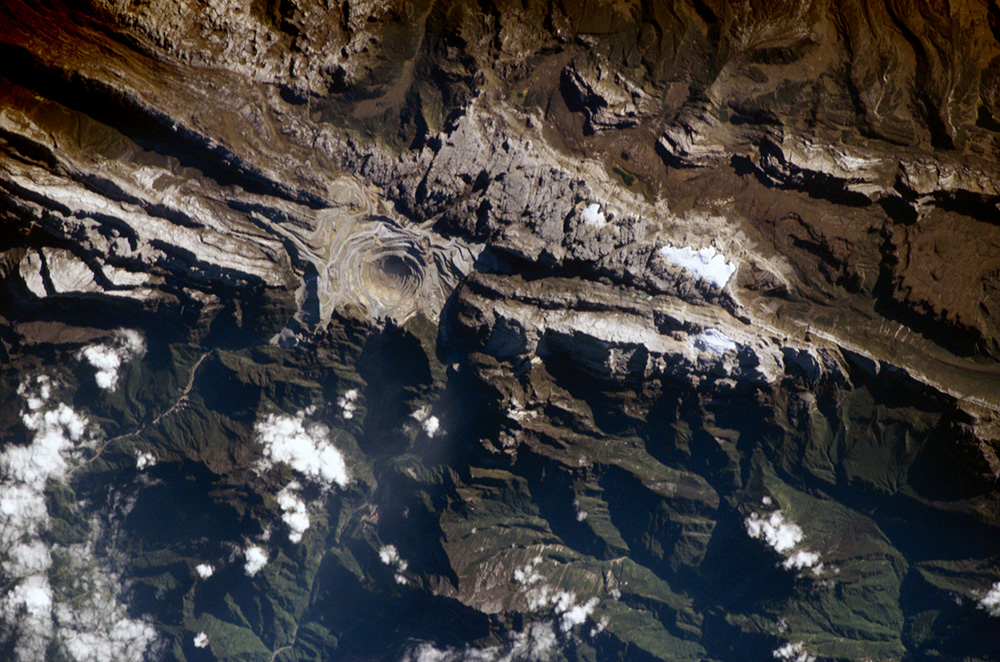
The Grasberg porphyry Cu-Au deposit, located at the crest Sudirman Mountains,
Papua, Indonesia is one of the largest copper and gold mines in the world.
Rare equitorial glaciers can be seen along the summit of the mountains to the
east of the Grasberg mine (Photo: www.eol.jsc.gov/EarthObservatory/Grasberg-Mine_Indonesia.htm,
public domain).
Another magmatic suite I am studying are post-collisional, intraplate, strongly
alkalic volcanic and plutonic rocks from the Grasberg mining district and the
Central Ranges in the western part of the island of New Guinea. Highly enriched
isotopic compositions indicative of the presence of ancient lithosphere have
been found beneath the western part of the island of New Guinea. A key question
is just how much of the distinctive isotopic signature can be attributed to
derivation from an ancient, enriched lithospheric mantle source versus crustal
level contamination? Secondly, what role did this enrichment play in the
formation of the giant Grasberg ore deposits?
.JPG)
Mine tailings in the Tri-State mining district, west of Prosperity, Jasper Co.,
Missouri. The Tri-State district covers portions of southwestern Missouri,
northeastern Oklahoma and southeastern Kansas and contained more than 4000
mines. For one hundred years (1850-1950) the Tri-State district produced 50
percent of the zinc and 10 percent of the lead in the United States.
More recently I have also begun to develop the analysis protocols for Fe, Cu, Zn
and Sb isotopes on the IsoProbe. The study of these isotope systems has recently
become possible with the development of new analytical instrumentation. These
isotope systems are being studied because of the information they could
potentially provide about equilibrium, kinetic, redox and biogenic processes
involved in the formation of ore deposits and lower temperature hydrologic
systems. Some current projects include Cu isotope studies of
mineralization from the Grasberg Cu-Au porphyry, volcanogenic massive sulfide
deposits in the eastern Pontides of northeastern Turkey, and Mississippi
valley-type mineralization in the Tri-State mining district of Missouri,
Oklahoma and Kansas.